編譯 Boost 1.35.0 (Visual Studio 2005 (VC 8.0) + Windows XP)

簡介

  1. Boost 的原始碼可以在官網 http://www.boost.org 找到,或是直接到 sourceforge 下載,網址是:http://tinyurl.com/m7jqo
  2. Boost 有著自己一套的建置系統,叫做 Boost.Build [1],可用在編譯、 安裝、測試等功能上。Boost.Build 則是架構於 Boost.Jam, Boost.Jam 又是 Perforce Jam[2] 的衍生,更詳細的介紹可以在 [3] 看到。
  3. 通常在 Windows 上安裝 Boost ,最快速、簡易的方法是去 Boost Consulting 下載 installer [4],不過到今天為止, Boost 1.35.0 的 installer 都還沒 release。所以大家來學學自己編譯吧 : )
  4. Boost Getting Started on Windows [5] 是一篇官方的教學文件,有簡易的 bjam 使用方法,但無註明完整安裝的步驟,另外它也簡介了Boost Project 的 layout, simple usage 等等。
  5. Boost 身為最先進、標準的 C++ library ,它大量使用了 generic programming, metaprogramming 等技巧,使得實際上需要編譯成函式庫(.lib, .dll)的部份反而少了,根據 Boost Getting Started on Windows [5] 的說明,只有以下幾個 library 使用時,一定需要先編譯成函式庫(.lib, .dll):
    1. Boost.Filesystem
    2. Boost.IOStreams
    3. Boost.ProgramOptions
    4. Boost.Python
    5. Boost.Regex
    6. Boost.Serialization
    7. Boost.Signals
    8. Boost.Thread
    9. Boost.Wave

    還有幾個則是 optional:

    1. Boost.DateTime
    2. Boost.Graph
    3. Boost.Test

安裝步驟

  1. 下載 source code 並解壓縮。
  2. 使用 Open Visual Studio 2005 Command Prompt 進入 cmd。利用 Open Visual Studio 2005 Command Prompt 的原因有兩點:
    1. 方便呼叫 namke, cl 等 vc toolchain。
    2. 若是電腦上安裝多個編譯器,使用 Open Visual Studio 2005 Command Prompt 通常可透過環境變數,讓 bjam 使用正確的 toolchain。
  3. 取得 bjam.exe。
    1. 可以選擇到 Boost 提供的預先編譯好的 binary,可在http://tinyurl.com/2q36f 下載。
    2. 或是自行編譯,以下是編譯步驟:
      1. $> cd your_dir\boost_1_35_0\tools\jam\src
      2. $> build.bat
      3. 執行完後,boost_1_35_0\tools\jam\src\bin.ntx86 下就放著編譯完後的 bjam.exe 了!
  4. 將上一個步驟的 bjam.exe 放入 PATH 環境變數或是使用絕對路徑呼叫 bjam,並搭配以下的 options 就可開始編譯並安裝 boost:
    • $> bjam.exe --build-dir="your_dir\boost_1_35_0" --build-type=complete --toolset=msvc install
    • --build-dir: boost 解壓縮的檔案,記得 = 前後不可有空白!
    • --build-type: complete 會產生 release, debug ,以及各種設定的對應:如 multithread, debug, 等等。
    • install: 編譯完後,將 header, lib 安裝到指定目錄,預設目錄是:C:\Boost,大小約 2 G。
  5. 更多的客製化安裝,可以使用 bjam --help 查看 options。
    • bjam 是個有趣的東西,當我在 your_idr\boost_1_35_0\tools\jam\src\bin.ntx86 下執行 bjam --help 時,它跑出的訊息並不多,而切換到 your_idr\boost_1_35_0 時卻又是另一回事,它跑出豐富的 Boost 的編譯資訊,後來發現它會去讀取 Jamroot 這個檔案,這是格外要注意的一點。

Reference

  1. Boost.Build: http://www.boost.org/doc/libs/1_35_0/tools/build/v2/index.html
  2. Perforce Jam: http://www.perforce.com/jam/jam.html
  3. Install Boost: http://www.boost.org/doc/libs/1_35_0/doc/html/bbv2/installation.html
  4. Free Download on Boost Consulting: http://www.boost-consulting.com/products/free
  5. Boost Getting Started on Windows: http://www.boost.org/doc/libs/1_35_0/more/getting_started/windows.html
  6. Boost 提供的 bjam binary 下載點(包含許多種平台): http://tinyurl.com/2q36f
  7. Boost Source on Sourceforge: http://tinyurl.com/m7jqo

Pipl: People Search

簡介

http://pipl.com/

      蠻有趣的一個網站,它專門用來找人的資料!可以使用:First/Last Name, City, State, Country 當關鍵字。並產生以下的結果(以 Bjarne Stroustrup 為例):

  • Quick Facts:  被查詢者快速資料。如 B.S. 是 C++ 的設計者。
  • Contact Details: 一些詳細的個人資料,如地址、電話等…
  • Profiles & Directories: 對方的個人資料,例如 B.S. 是學術中人,所以會有一些 indexing 或資料庫的個人自傳,演員的話還會幫你連結到 imdb 。
  • Publications: 著作嘛!查 paper 時,也可以來用一下?!可以對應到 cholar.google.com 不知道 IEEE, ACM 等專業期刊之後會不會列入?!
  • Web Pages: 相關的個人網頁,如果對方有上 wiki 之類的百科,也會列出來。
  • More: 上述的每一個項目都可以透過 more 連結到 google ,將結果以 google search
    呈現。

技術

     這個網站跟一般搜尋引擎有什麼不同呢?根據它網頁的說法是,一般抓網頁機器 人都只能抓到 surface web (主要是靠超連結串起的網頁)[3]。而另外有些網頁是以 online database 等非超連結方式儲存內容,稱作 deep web ,想抓這類的資料,你的機器人要能跟 online database 互動,也就是這些 online database 可能會有 search engine,你的機器人要能跟它們 talk talk ,不過望頁倒是沒有提到:它們所謂的互動是暴力互動(如:使用人名搜尋後,在進行資料萃取、整理)呢?還是有使用到一 些人名特徵的問法(如:Bjarne Stroustrup, telepone)。而這網頁的搜尋有點慢, 猜測是因為它只是個 mashup 的服務,背後都是 yahoo people、google scholar、 ZabaSearch。

用途?

     有時候看 mailing list 時,都會看到一些不錯的回答,若想知道對方更詳細的資料就可以透過這個網站,或許以後大家當老闆了,面試別人前,也可以來 pipl 一下唷!

學術?

     The Deep Web: Surfacing Hidden Value [1] 這篇文章提到 deep web 的資料量是 surface web 的 500 倍多(而且可能更具價值?!還沒看完文章,所以不知道), wiki [2] 列出了一些有趣的研究,有興趣的人,可以朝這發展?!

Reference

  1. The Deep Web: Surfacing Hidden Value: http://www.press.umich.edu/jep/07-01/bergman.html
  2. Deep Web - Widipedia: http://en.wikipedia.org/wiki/Deep_web
  3. Surface Web -Wikipedia: http://en.wikipedia.org/wiki/Surface_Web

Single/Double/Multiple Dispatch - Part 1

Design PatternGenerative ProgrammingModern C   Design Cover

     GoF 的 Design Patterns [1] 一書在 Visitor pattern 的實做描述中提到了 single/double dispatch,並針對 single dispatch 給了這樣的說明:

In single-dispatch languages, two criteria determine which operation will fulfill a request: the name of the request and the type of receiver

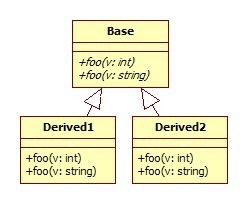
     若要快速地瞭解這句話,我們不妨白話點:函式的喚起是倚賴 function overriding (dynamic polymorphism) 與 overloading (static polymorphism) 的合作而完成的。以 C++ 為例,假設我們有以下的繼承架構:

hierarchy

當我們寫下這段程式碼時:

Base* ptr = new Derived1;
ptr->foo( 1 );
會被喚起的函式是 Derived1::foo( int ),而非 Base::foo( int ) ,當然更不可能是 Derived2::foo( int ),這是 function overriding (dynamic polymorphism),以 C++ 說,因為當下物件 ptr 的 vtbl 指向的型別是 Derived1 而非 Base ,這也就是 GoF 書中提到的 type of receiver 的部份。至於為何是 Derived1::foo( int ) 而不是 Derived1::foo( string ),就是倚賴 function overloading ,相當於GoF 書中提到的 name of the request 。

     那什麼是 double dispatch 呢?耶,有 double ,那有沒有 triple 呢?quadruple 呢?…?答案是有,而且我們還習慣把它們合在一稱為 multiple dispatch ,在另一本 OO 聖經書籍 Generative Programming [2] 中提到:多型機制可分為兩大類:single dispatch 和 multiple dispatch (又稱 multimethods):

Single dispatch corresponds to the Smalltalk idea of sending a message to an object, where the appropriate method (i.e., message implementation) is selected based on the type of the reciever.
…
Single dispatch introduces asymmetry with respect to the arguments because the first argument is treated specially.
…
A dispatch mechanism that uniformly uses all argument types for selecting the method is referred to as multiple dispatch, or mutlimethods.

     從上面的解釋中我們不難體會:常見語言(如:C++, Java, C# )的動態多型呼叫是可轉換成對等的 C 語言,轉換的虛擬碼如:

// C++
Base* ptr = new Derived1;
ptr->foo( 1 );

// C
foo_in_c( ptr, 1 );
foo_in_c( Base* ptr, int i )
{
	if ( "Base" == ptr->type_info() )
		Base::foo_in_c( i );
	else if ( "Derived1" == ptr->type_info() )
		Derived1::foo_in_c( i );
	else
		Derived2::foo_in_c( i );
}

我們可以透過 this 得到 ptr 的記憶體位置,並傳給轉換後的 foo_in_c 去決定該喚起的是哪個 method ,這種將第一個參數特別挑出來檢驗的機制就稱作 single dispatch ,反之,若是今天 foo 有 N 個參數,函式的喚起得考慮 run-time 時,每個參數的實際型別,那就是 multiple dispatch 。

     Multiple dispatch 比起 single dispatch 更具有表達與描述威力,因為同一個時間點,它同時考慮了多個 物件的 run-time 型別。而目前只有少數語言有支援這個特色:如 CLOS 。其他語言則需要透過 extension 。[7] 羅列了一些這類的整理資料,

     針對 C++ ,除了找 extension 外,還可以在經典書籍 Modern C++ Design 的第十一章,看到 Andrei 的一些討論。另外,[9] 這篇 C++ Report 的文章也提出了一個解法,[10] 則針對上面兩個方法有所簡單討論, [9] 也是從這找到的。

Reference

  1. Design Patterns: Elements of Reusable Object-Oriented Software by Erich Gamma, Richard Helm, Ralph Johnson, 1998
  2. Generative Programming: Methods, Tools, and Applications by Krzysztof Czarnecki and Ulrich W. Eisenecker, Addison Wesley, 2000
  3. Generative Programming: http://www.generative-programming.org/
  4. Modern C++ Design: Generic Programming and Design Patterns Applied by Andrei Alexandrescu, Addison Wesley, 2001
  5. Dynamic Dispatch - wikipedia: http://en.wikipedia.org/wiki/Single_dispatch
  6. Double Dispatch - wikipedia: http://en.wikipedia.org/wiki/Double_dispatch
  7. Multiple Dispatch - wikipedia: http://en.wikipedia.org/wiki/Multiple_dispatch
  8. Single, Double and Multiple Dispatch: http://ifacethoughts.net/2006/07/29/single-double-and-multiple-dispatch/
  9. Multiple Dispatch A New Approach using templates and RTTI: http://www.eptacom.net/pubblicazioni/pub_eng/mdisp.html
  10. Re: 備份 : Multiple Dispatch: http://phpbb.godfat.org/viewtopic.php?t=204&highlight=&sid=0ffb75220260fea3aa497c8a17fe710b

MiniFilter InstanceSetupCallback is not called?

一般來說,MiniFilter 的 InstanceSetupCallback 會在 filter manager 把 minifilter attache 到 volume 後呼叫。如果沒有的話,可以檢查一下 minifilter 的 INF 是否把 instance fla...